Advice needs a relationship.
Generic advice and fear of blame could hinder candour with clinicians. Follow-up and a trusted human contact mattered.
Some interactions could not load. The story and full-size image links are still available.
MRES THESIS / METABOLIC SYNDROME
Managing a chronic condition is a daily job. My thesis explored how a service could make it less fragmented, less overwhelming and easier to fit into everyday life.
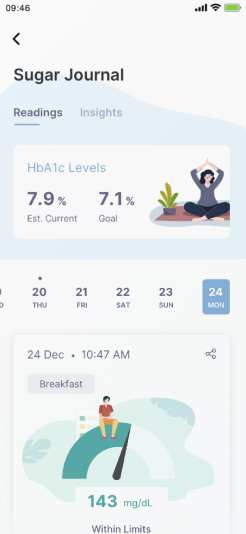
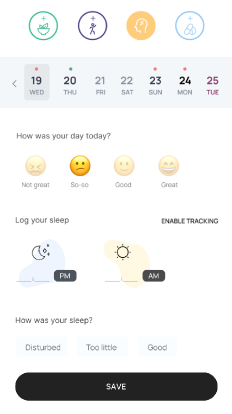
Illustrative health values, not medical guidance.
Participation figures from an exploratory, non-representative study.
01 / INTRODUCTION
How might we empower people in urban India to prevent and manage metabolic syndrome and Type 2 diabetes?
Metabolic syndrome brings together related health risks, but managing them crosses separate places: a doctor’s appointment, a prescription, a meal, a workout and the next test.
I wanted to understand the choices between those touchpoints. What felt “healthy”? What made change worth the effort? When did advice stop fitting someone’s life?
I focused on day-to-day management of diabetes, obesity and hypertension, excluding acute complications and severe deterioration.
I explored awareness, access, habits, emotional needs, spending and openness to technology to shape an intervention, not a treatment protocol.
THE THESIS, IN BRIEF
The mixed-method study led to a connected care-service concept: manageable steps, personal support and lasting habits. The app was one part, not the whole answer.
02 / METHODS & METHODOLOGY
The Double Diamond connected secondary research, people’s accounts, everyday behaviour and co-designed possibilities.
Literature review and an exploratory survey.
Interviews, design probes and thematic synthesis.
Co-design, prioritisation and service definition.
Wireframes, visual language and a connected prototype.
I reviewed conditions, management and urban Indian life through databases including MEDLINE, EMBASE and Global Health, using explicit inclusion criteria and a PRISMA record.
Primary research combined a social-media survey, semi-structured interviews and design probes. I used frequencies and cross-tabulation for closed responses, thematic analysis for open responses.
The RCA Research Ethics Team approved the work on 12 November 2020. Participant information and consent covered interviews, diaries, focus groups and testing.
Personal networks and social media shaped recruitment; later participants had access to urban services and technology. These small, self-selecting groups were not representative.
03 / DISCOVER
The literature gave me a map. The survey showed me where to look more closely.
I explored how work, family, food culture, beliefs, mental wellbeing and care access intersected. A Johari Window separated my understanding from questions the literature left open.
Recommendations were plentiful. Making sense of them, acting on them and keeping going was harder.
I analysed 51 survey responses on diagnosis, management routines, devices, record-keeping, app use, emotional friction and COVID-19 changes.
Time pressure, unclear information, difficult routines and uncertain progress stood out. I focused next on adults aged 25–45, who combined interest in new approaches with everyday obstacles.
Why did recording readings feel unhelpful? What made advice hard to follow around meals or work? How did trust, family support and a doctor’s language affect what happened next?
The questionnaire also covered demographics, condition history, management priorities and difficulties, device motivations, app deterrents and perceived pandemic effects. These informed interviews, not a feature checklist.
04 / DEFINE
Interviews and design probes made the practical and emotional parts of management harder to separate.
Twenty survey respondents were taken forward for interviews to explore care journeys, relationships and the gap between knowing a change mattered and making it happen.
Three research portraits explored different circumstances: the sedentary adult, busy parent and proactive senior. They were lenses, not fixed labels.
Four participants used three design probes: an activity book with emotional cues, a 60-second reflection and postcards exploring visual associations.
The probes surfaced values, daily routines and feelings direct questions might miss. Anxiety, guilt, frustration and confusion belonged within the care experience.
Generic advice and fear of blame could hinder candour with clinicians. Follow-up and a trusted human contact mattered.
Regional food, family meals, celebrations, work and time pressure shaped what felt realistic.
Unclear progress made routines hard to sustain; monitoring could bring anxiety rather than reassurance.
Six themes emerged: consultation, medication, diagnostics, diet and nutrition, physical fitness, and mental health. I mapped the patient journey across clinicians, family, pharmacies, diagnostic, nutrition and fitness services.
Knowing lifestyle changes mattered did not make them easy. Existing beliefs, selective attention and blame within care relationships became design considerations.
I translated the synthesis into open “How might we” questions for participants to explore.
05 / DEVELOP
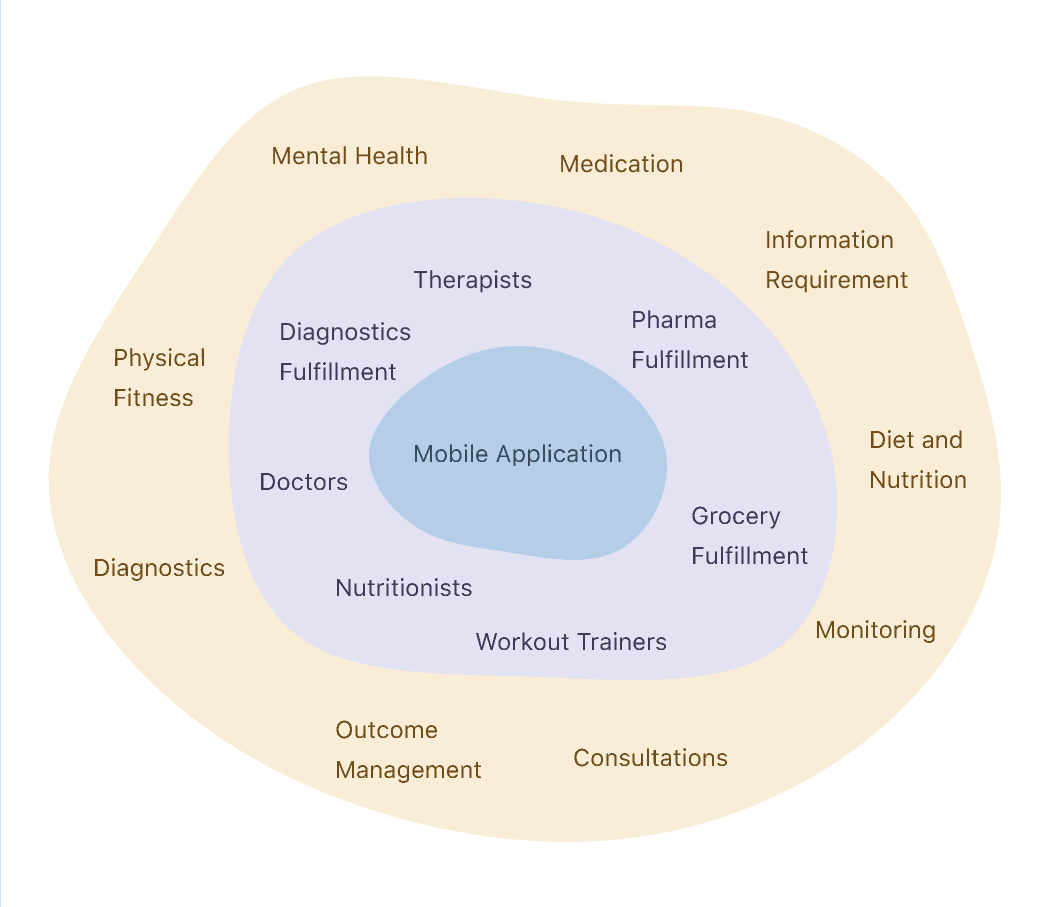
Four participants joined remote co-design workshops, moving from shared problems to ideas, priorities and a connected service.
Themed workshops began with research and “How might we” questions, followed by two rounds of Crazy Eights, scenario prompts and dot voting on Zoom and Miro.
Participants wanted a connected team, useful feedback and personal support, not another tracker.
Across the six care themes, I considered the connecting information, motivation and monitoring.
I compared analogous services’ focus and availability in India. The concept needed to fit local care, not import another market’s model.
THE 3S MODEL
Step-by-step interventions, with a clear next action instead of an overwhelming set of instructions.
Insights and changes shaped around the person’s concerns, preferences, context and care needs.
Habits supported by check-ins, visible progress and a plan that can change when life does.
The concept linked a chosen doctor to an assigned expert coordinating diet and fitness, supported by messaging and check-ins. Partner services covered diagnostics and prescription fulfilment; medication decisions stayed with the doctor.
Regional and family meal plans came with recipes and optional grocery fulfilment. Fitness choices ranged from walks to guided exercise, with room to record unplanned activity.
Support after diagnosis included family involvement, mindfulness and access to professionals. Expert-reviewed information and empathetic communication aimed to make care understandable and less judgemental.
Goals and reviews connected daily actions to longer-term objectives. Wearable data and temporary glucose monitoring could inform a professionally supported care plan, rather than leave people interpreting numbers alone.
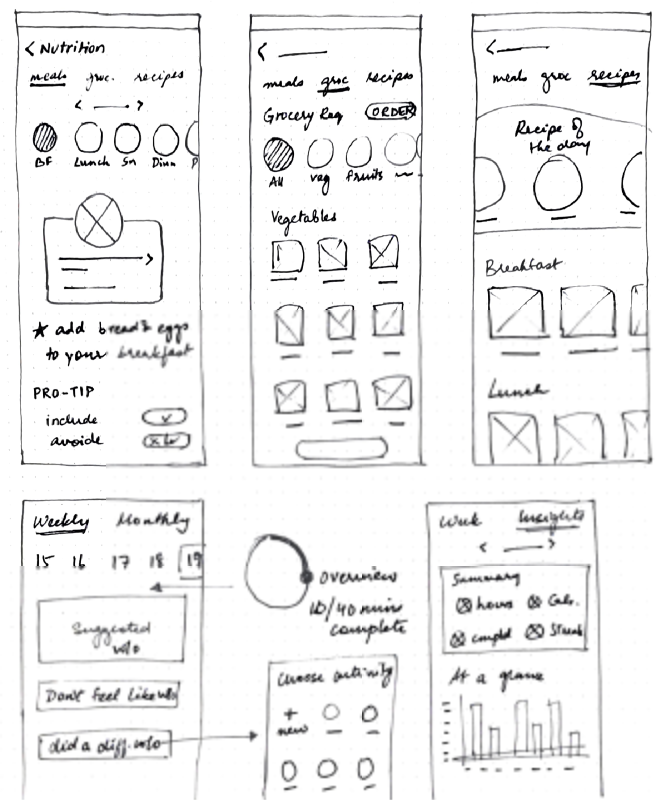
Participants often named diabetes, hypertension or obesity rather than “metabolic syndrome”.
I used those conditions and their combinations as entry points, targeting adults aged 25–50 in tier 1 and 2 Indian cities. These examples follow the diabetes path.
Co-design participants’ wireframe walkthroughs informed revisions to the information architecture.
06 / DELIVER
I developed the visual language, icons, illustrations, colour system and prototype around one principle: empathetic, understandable communication.
Neutral, respectful language avoided blame. Organic illustration and a muted palette supported daily use. I developed the interface from wireframes and connected the flows in Sketch.
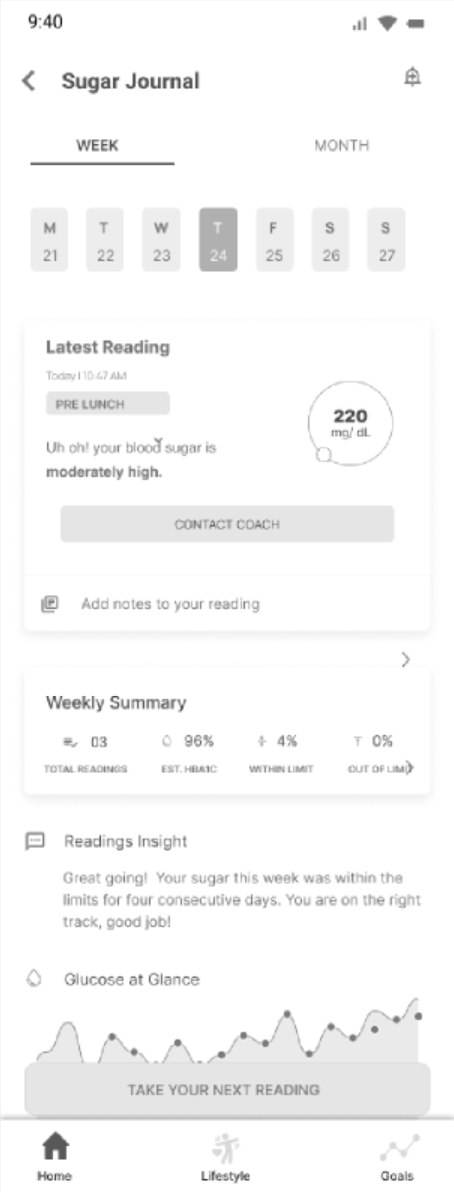
Mood and sleep sat alongside activity and readings, giving the service more than a single measurement.
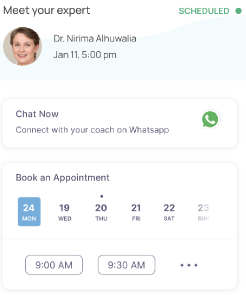
Expert contact and appointments linked the interface to the care team: a route into support, not a substitute.
Explore the thesis prototype in Sketch07 / DISCUSSION & CONCLUSION
The strongest idea was a service connecting care, daily life and the support needed to keep going.
I developed a research-informed service concept, revised its architecture with participant feedback, and built the interface and prototype.
Chronic care became a relationship across people, routines and organisations. Improving touchpoints mattered; making them work together was the bigger problem.
sugar.fit was built entirely on this thesis: the idea, the research and the solution. I pitched the work to leadership at cult, and we created a subsidiary to bring it to life. I was sugar.fit’s founding designer.
When my thesis became realClinical benefit and long-term adherence remained untested. Small, self-selecting groups and the pandemic limited generalisability.
Next came questions of sustained use, broader accessibility, care-team operations and delivering support over time.
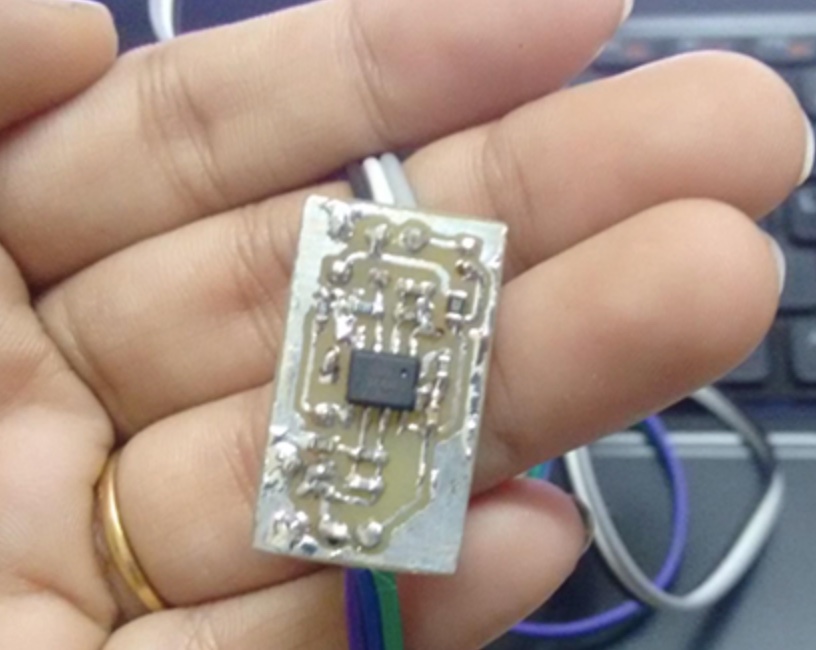
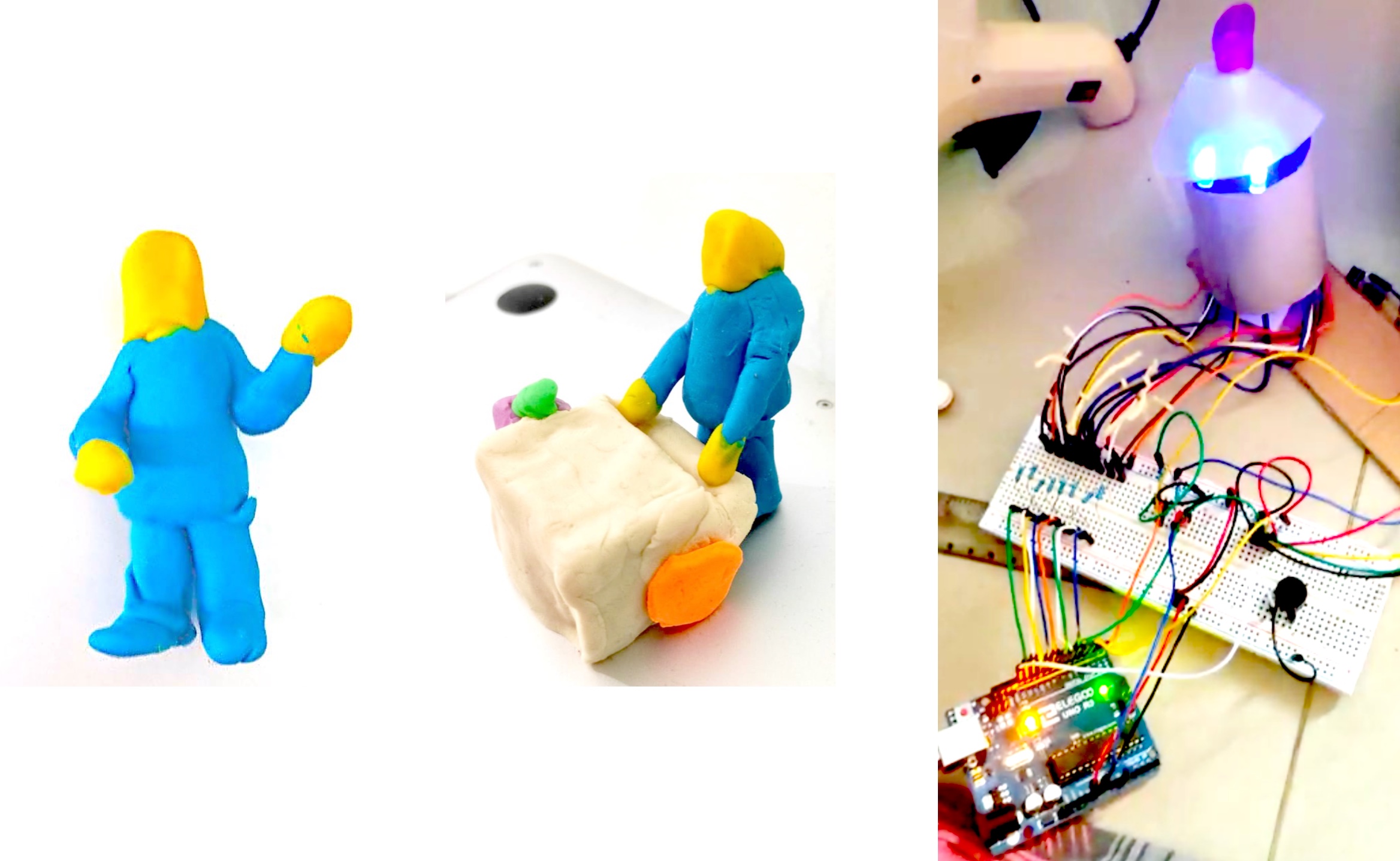
An early bio-impedance exploration began with the burden of repeated finger-prick measurements, documenting a circuit, apparatus and two experiments.
This remained exploratory. The experiments did not establish clinically reliable glucose measurement or a safe replacement for a validated monitor.
08 / APPENDICES
Supporting material offers a closer look without interrupting the story.
The introduction, recruitment posts and questionnaire record how people were invited and what they were asked, across context, diagnosis, routines, monitoring, technology, the pandemic and management challenges.
Survey appendixThe thesis includes RCA approval, participant information and consent documents. Identifying research records are withheld.
Ethics appendixTwo experimental records document the exploratory circuit and apparatus.
Experiment appendix09 / REFERENCES & CREDITS
Empowering the urban Indian population to manage Metabolic Syndrome: A Design Practice Led Approach.
The thesis holds complete citations for clinical and contextual literature, behaviour, methods and service design, alongside contents, figure and table registers.
Open the thesis and working boardsCompleted for the MRes Healthcare & Design programme at the Royal College of Art and Imperial College London, with supervision from Prof. Ashley Hall, Anna Wojdecka and Dr. Saira Hameed.
Thank you to the participants who shaped the work, and the tutors, family, friends and colleagues who supported it.
MetS means metabolic syndrome. T2DM means Type 2 diabetes. HMW means “How might we”. The thesis uses AGM for ambulatory glucose monitoring.
The opening condenses the abstract. All nine thesis chapters are represented, from introduction and methods through design, discussion, appendices and references.
OTHER QUESTIONS I FOLLOWED